Most of the fish we find offshore in Hawaii, we find because of birds. Some days we do not even put lures out when we leave. We catch bait in the morning, run to a zone where fish were reported, and hunt for bird piles. The birds are not just telling you there is fish. They can tell you what kind of fish, and whether a pile is worth your time or not.
This post is how we decide which birds to work, which ones to drive past, and how to approach a pile without pushing the school away. A lot of it is how the captain fishing with us broke it down after a slow day where a few stray birds turned into a hooked up ahi.
Here is the short version of what we look for:
The first thing is learning the difference between the small flutter birds and the boss birds, the sooties and boobies. Flutter birds are the ones you see first, and most people drive right past a couple of stray ones. But watch how they fly. If two flutter birds are working a certain area, not really flying fast and not going far away, they are on something.
The confirmation is the boss birds. When a sooty or a booby shows up and decides to stay and work for a little while, that stay is the signal. If they even stay for a few seconds, that tells me there is a fish there, versus the flutter birds going crazy over a piece of rubbish. The boss birds do not waste time on trash.
That is exactly how the ahi happened on our slow day. Picture a completely desolate ocean, no activity except a few stray flutter birds. Most people would have driven by. The captain knew by the way the birds were acting that there should be something around. The light was too low to see fish in the water, and it took a few passes to get under those birds with a live bait, but the right pass came and we were hooked up to an ahi off a pile everybody else would have ignored.
When you commit to a pile, figure out which birds are the beaters, the head guys. All the other birds follow them. Plan your attack on where the lead birds are going, not on the whole flock milling around.
Same thing with splashes. Just because a fish splashes to your left does not mean you turn left. Watch the birds. If you overcompensate and swing left, those birds can run to your right, and now you are completely behind the pile and chasing it all over again. The birds react to where the fish are heading, so follow the birds and you stay ahead of the school.
Not everything working a pile is good news. On one aku run we came up on a pod of either pilot whales or melon heads sunbathing near our zone, and the honest reaction was hopefully they did not kill our spot.
Rough toothed porpoise are the clear signal to leave. When a big pile of them moved in on the aku we were working, we abandoned it. Even if we caught an aku and tried to use it for bait, they will steal it while you are reeling it in, or the second you throw it back out. The bite goes slow and you are feeding porpoise. Make one more circle, then go look for something else.
Sharks come with the life too. On that same day a small oceanic whitetip, maybe a three or four footer, ate a small fish off our line on the outskirts of a pile. We cut him loose and went back to the Aku Bones. Lots of life does not always mean lots of fish.
On aku runs we mark the lines, throw two Aku Bones on the riggers, and do a high speed run up to the zone. If there are boats around when we get there, I troll a short line and slowly work circles to assess what is going on before committing to a game plan.
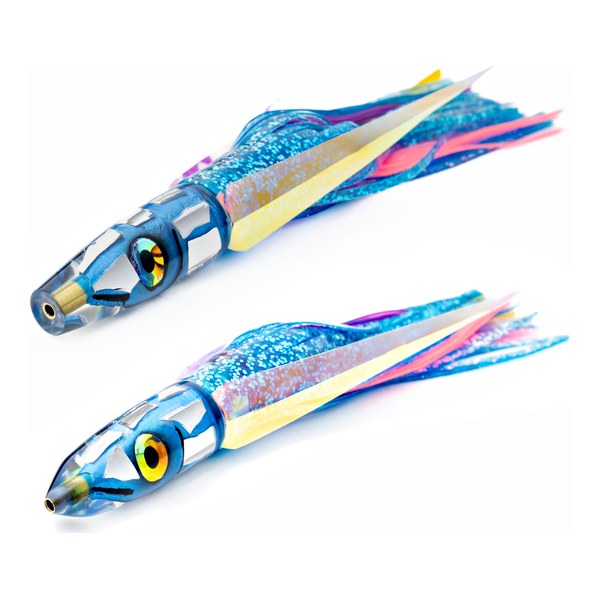
If small aku are jumping around the birds, we break down and go smaller: smaller lures, slower speed, shorter lines. We made three or four circles on one pile before making that change. I even ran a little pink minnow strip lure from Maui Sporting Goods that day, because pink is the best color for that. Small lures like our 5 inch Ballyhoo and the 6 inch Pee Wee Flyer are built for exactly this situation. Once you are dialed in on the pile, how you set those lines matters too, and I covered that in my post on adjusting your spread.
Reading birds is the difference between coming home with something and coming home with nothing. The guys who steadily catch fish do not get a bite every time they go out. They make the most of what they see on a slow day and work the pile in front of them before venturing off. That is the difference between the guys catching one or two ahi and the guys catching three or four, or catching the one when nobody else is catching.
You can get a lot of this by asking people, and I did exactly that. But you have to put your time in on the water to see it for yourself and remember it. You are not going to learn sitting on land reading magazines and watching videos. Unless you go, you will never know.
Comments will be approved before showing up.

Some of my best days started as busted ahi plans. Here is how I find and work floating rubbish in Hawaii, from hunting speed between piles to the six inch lures and Aku Bones that go in the water first when I break down.

I run a 9-inch spread during ahi season, but the 7-inch and 6-inch lures earn their spot in the box for everything else. Here is how I use each size, when I reach for the Ali’i heavy series in rough water, and why I pull them all out once that 3-month ahi window opens.

We sell or give away the best cuts of every ahi, and the fisherman keeps the rest. Here is how I smoke the head, why the meat around the eyes smells like crab, and how what is left turns into a really good head soup.

Join the Tsutomu crew for early drop alerts, fish reports, and tips from the water.
Drops sell out. Add your number and get a text on every drop and restock before Instagram or email finds out.
By providing your phone number, you agree to receive promotional and marketing messages, notifications, and customer service communications from Tsutomu Lures. Message and data rates may apply. Consent is not a condition of purchase. Message frequency varies. Text HELP for help. Text STOP to cancel. See terms, see Privacy Policy.
Here’s 15% off your first order. Tap the code to copy it, or shop now and it applies at checkout automatically.