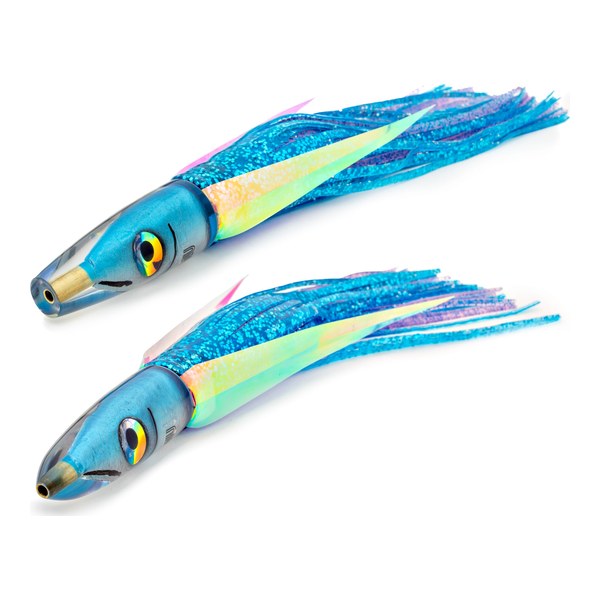
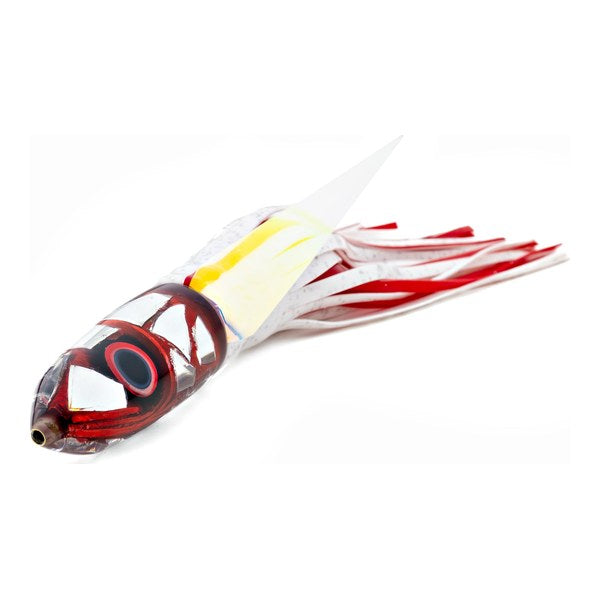
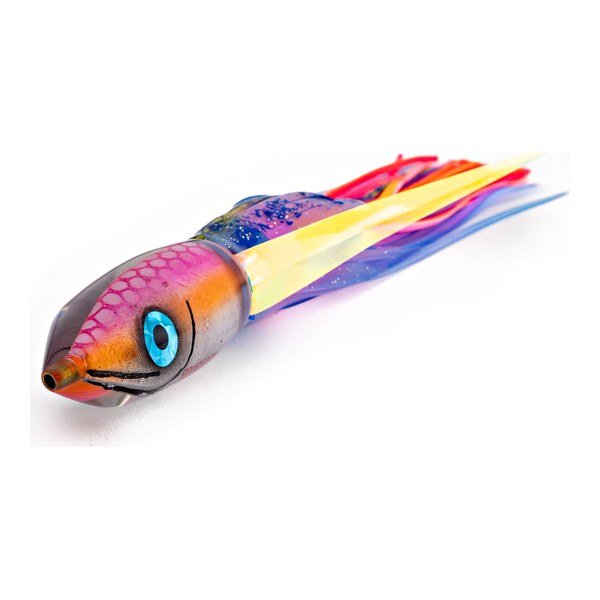
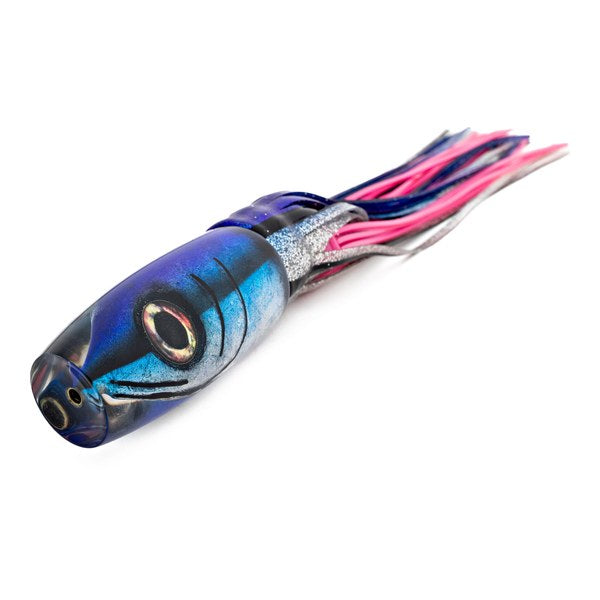
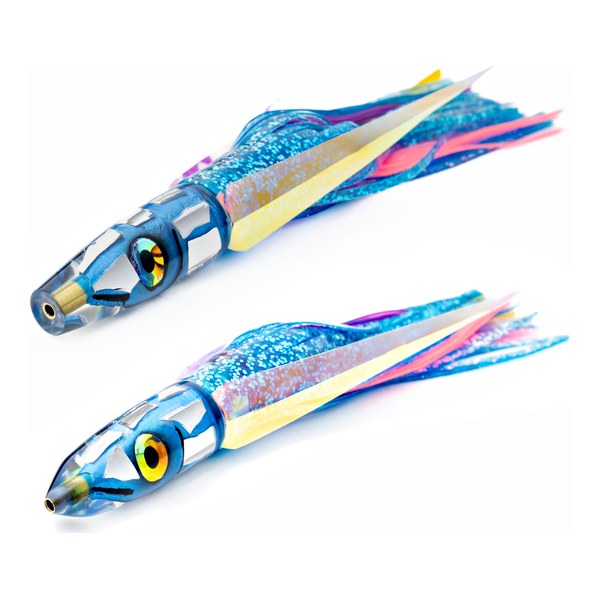
Manufacturing is probably the hardest part of this business, and it is probably why so many companies outsource their lures overseas. We still build every lure at our shop here in Hawaii, start to finish. People ask what actually goes into one of our heads, so in this post I am going to walk you through the whole process the same way I showed it on our YouTube channel, using two lures as examples: the H-1 Series fish head, which is one of our more expensive lures because of how long the process takes, and the 9 inch Ice Blue Moke Bullet.
One thing to understand first: in Hawaii, the lures that carry a certain name have earned their reputation because they have caught fish for generations here. That is the standard we are trying to live up to every time we pour a head.
Here is the full sequence on an H-1 fish head, in order:
After all that, the head gets skirted and winged, and it is ready to fish.
The H-1 starts as a lead pipe and a bunch of scrap lead. We melt the lead down and pour it into a mold, and what comes out is a balanced lead blank. If you hold one and roll it, it rolls over to the right spot every time. That balance is built into the lure before any resin ever touches it, and it is what makes the finished head ride the way it should.
Next we wrap the lead in whatever reflective paper the lure calls for. On this H-1 it is a star paper inlay that sits inside the fish head insert. Then we pour the insert itself. It comes out of the mold as a plain white blank, so we sand it down and clean it up to get it ready for paint.
Paint is where the hours go. The H-1 I walked through on camera took five passes: a pearl white underneath the orange, then purple, then a pearlized combo blue, which is a passive white with a passive blue sprayed over it, and then the black of the eye. What you see on the rack is layers you cannot see anymore, and that is what gives the head its depth in the water.
We make our own resin eyes here at the shop, set the eye by hand, and then hand draw the gills on every fish head.
I like paint jobs that shift color depending on the angle you look at them. That is what you get when you look at a real fish, a flash of color wiggling around or trying to escape, and that is what we are trying to put in front of the ahi.
The painted insert goes into the regular outer resin mold, and the head pops out rough. On an invert we actually cut the tail pattern out on the lathe. From there it goes into the tuning box, where we fine tune the shape, then fine sand and polish it.
That last stage is a lot like making a surfboard. A machine or a mold can get you to the rough shape, but then somebody has to go in by hand, smooth out the lines, and get it to the exact shape. We call it fine tuning the shape, and it happens on every head.
Nothing goes into production because it looks good on the rack. When we were developing the Blunt Bullet, I ran the 7 inch and a 9 inch blunt invert as testers on my own boat, and I ran the test lure short mainly because I wanted to watch how it swam. The Purple Disco went the same way: we made one head to match the purple salmon skirts, gave it to the Reel Addiction crew, and they caught fish on it right away. We already knew the skirt combination worked, so once the head proved itself on the water, it went into production.
We also warranty our lures against normal wear and tear. When you build them yourself, you can stand behind them.
Once the head is polished, we pick the skirts. On the 9 inch Ice Blue Moke Bullet that is ice blue over a creamsicle underskirt, which is the standard ice blue here in Hawaii. Some guys run purple, or purple and black, underneath instead. Ice blue is a staple in pretty much everybody's lure box in Hawaii because it can resemble a lot of things: on its own it reads like a small baitfish, and with the creamsicle under it, it leans more toward a shrimp pattern. Then the wings go on, and the lure is ready for hooks. If you want the full skirting process, I covered it step by step in our skirted trolling lures guide.
That 9 inch Moke Bullet is mostly a big tuna lure for us. People have success with it on the corners and on the riggers, it works as a stinger lure if you are chasing marlin, and it will run in any position effectively.
It is a lot of work and a lot of steps, but we like the end result. We make lures with an artistic touch, for the fishermen who appreciate the craftsmanship and the art side of it. We are not a brand for everybody, and that is fine with us. If you want to see the process on camera, both videos are below, and every head in the H-1 Premium Series, like the H-1 Ice Blue, went through every step you just read.
Comments will be approved before showing up.

Some of my best days started as busted ahi plans. Here is how I find and work floating rubbish in Hawaii, from hunting speed between piles to the six inch lures and Aku Bones that go in the water first when I break down.

I run a 9-inch spread during ahi season, but the 7-inch and 6-inch lures earn their spot in the box for everything else. Here is how I use each size, when I reach for the Ali’i heavy series in rough water, and why I pull them all out once that 3-month ahi window opens.

We sell or give away the best cuts of every ahi, and the fisherman keeps the rest. Here is how I smoke the head, why the meat around the eyes smells like crab, and how what is left turns into a really good head soup.

Join the Tsutomu crew for early drop alerts, fish reports, and tips from the water.
Drops sell out. Add your number and get a text on every drop and restock before Instagram or email finds out.
By providing your phone number, you agree to receive promotional and marketing messages, notifications, and customer service communications from Tsutomu Lures. Message and data rates may apply. Consent is not a condition of purchase. Message frequency varies. Text HELP for help. Text STOP to cancel. See terms, see Privacy Policy.
Here’s 15% off your first order. Tap the code to copy it, or shop now and it applies at checkout automatically.