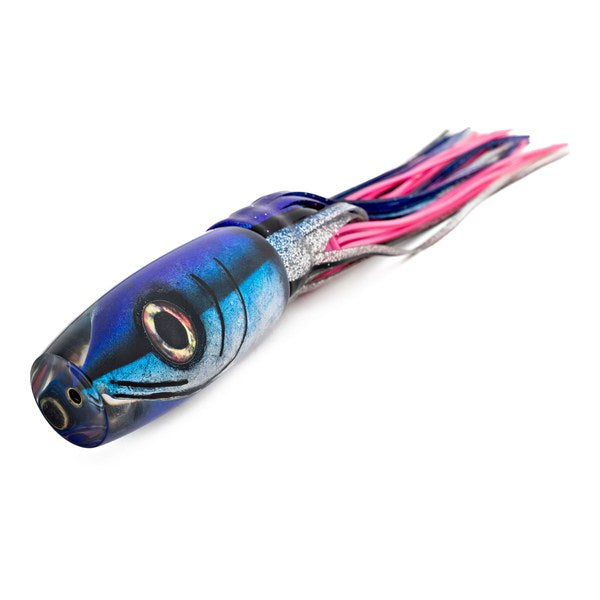
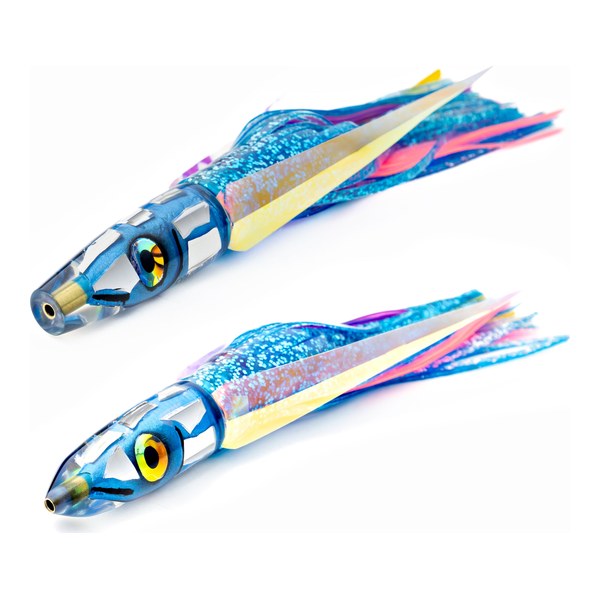
When you skirt a lure, you tie the neck of the skirt onto the collar and then flip the material back so the legs hang down. The issue with a thick skirt is at the fold point.
A thin skirt, something like a Yamashita MAV, has almost no material at the neck. When you flip it back, it sits flat. The back of the skirt transitions smoothly into the step of the lure head.
A thick skirt is a different story. If you have a cream skirt with three or four colors layered together, that material at the neck is dense. When you flip it back the standard way, you get a bulge right behind the step of the head. That hump is not just an appearance problem. Water flows over your lure head at trolling speed constantly. Any irregularity in that surface changes how the lure runs. You want the lure head to transition smoothly from the back step all the way to the tail of the skirt. A bulge disrupts that.
Instead of flipping a thick skirt back over itself, I trim the neck ring off before I commit to the final tie.
First, lubricate the skirt. I use coconut oil. Silicone spray goes everywhere; coconut oil stays where you put it. Once the skirt is lubricated, I position it exactly where I want it on the collar. I line it up side to side so the colors are centered, and I make sure it sits flush against the back step of the head.
Then I tie it on in place, in the final orientation, without flipping. Left-right-over-left twice, close the knot with wax string, trim the floss.
After the skirt is secured, I take a small scissors and trim the neck ring off. That ring is what causes the hump. Once it is gone, the dense material fills the gap between the back step and the front step naturally. Because thick skirts are heavy with material, they fill that gap without sagging. The lure goes from step to skirt tip with no drop and no bulge.
For a double skirt setup, where the top skirt starts matters.
You want the legs of the front skirt to begin right over where the back skirt legs begin. If you position the front skirt too far forward, the legs from the top skirt end up clamping down on the back skirt and it cannot open up properly. Start the front skirt just far enough back that there is a slight overlap, but not so much that the top skirt is collapsing the one underneath it.
| Skirt material | Flip back? | Trim the ring? | Lubricant |
|---|---|---|---|
| Thin (single layer, MAV style) | Yes | No | Coconut oil |
| Thick (multi-color, dense) | No | Yes | Coconut oil |
For both: position the front skirt legs to start over the back skirt legs.
Once both skirts are tied, look at the back of the head from the side. You are checking the profile from the back step of the head to the tip of the skirt. You do not want to see the skirt sinking into a gap behind the step, and you do not want to see it bulging out.
Think about water moving over that profile at four to five knots. You want it to ride over the head cleanly and push the skirt back in one smooth motion. Anything that breaks up that surface changes the way the lure tracks.
When you are re-skirting lures in the same session using different colors, you are probably switching between thin and thick materials. Take ten seconds to identify the material before you start. It saves you from pulling the tie off and starting over once you see the hump.
For skirt color combinations and codes, see the post on tuna lure skirt combinations. For the full tying walkthrough from scratch, the skirted trolling lures guide covers the basics.
Comments will be approved before showing up.


The calendar says ahi season in Hawaii starts in June, but the last few years the fish have been showing up as early as January and March. Here is how I get the boat, the leaders, and the lure box ready before they arrive.

Some of my best days started as busted ahi plans. Here is how I find and work floating rubbish in Hawaii, from hunting speed between piles to the six inch lures and Aku Bones that go in the water first when I break down.

Join the Tsutomu crew for early drop alerts, fish reports, and tips from the water.
Drops sell out. Add your number and get a text on every drop and restock before Instagram or email finds out.
By providing your phone number, you agree to receive promotional and marketing messages, notifications, and customer service communications from Tsutomu Lures. Message and data rates may apply. Consent is not a condition of purchase. Message frequency varies. Text HELP for help. Text STOP to cancel. See terms, see Privacy Policy.
Here’s 15% off your first order. Tap the code to copy it, or shop now and it applies at checkout automatically.