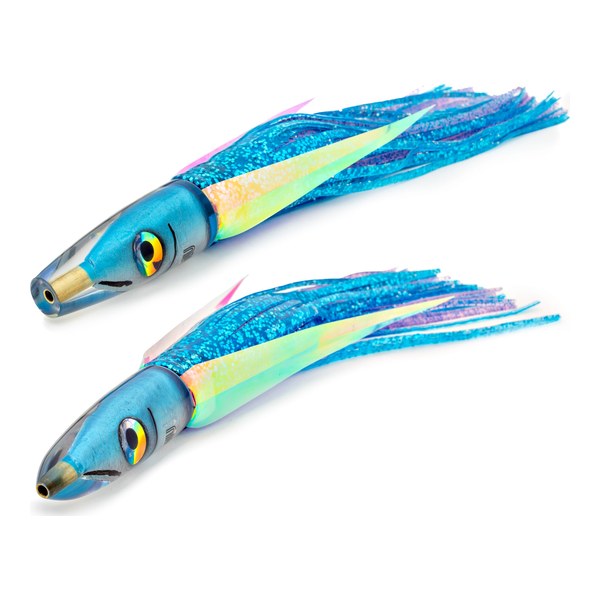
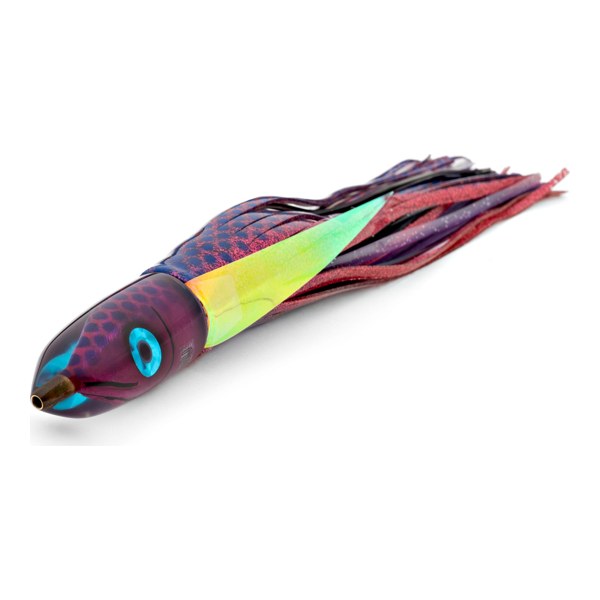
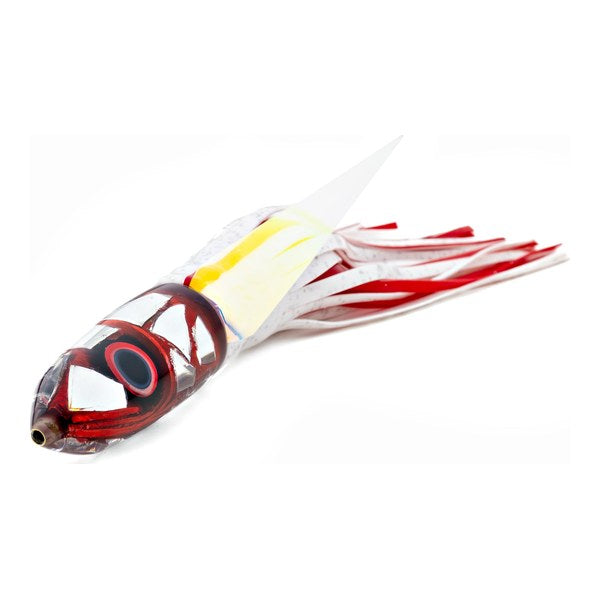
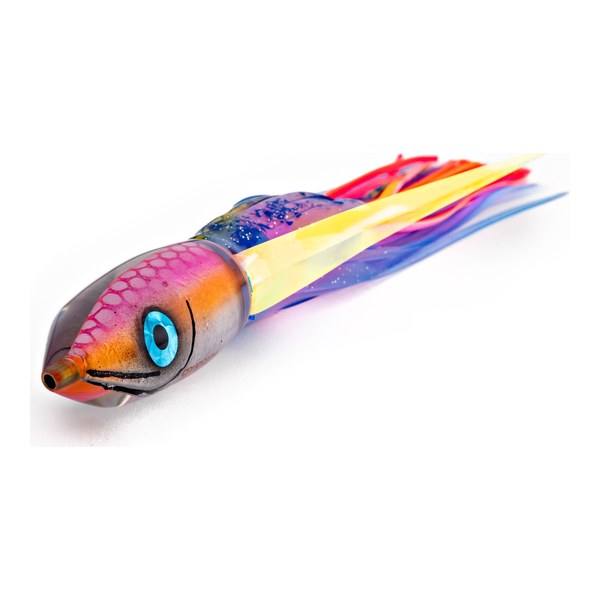
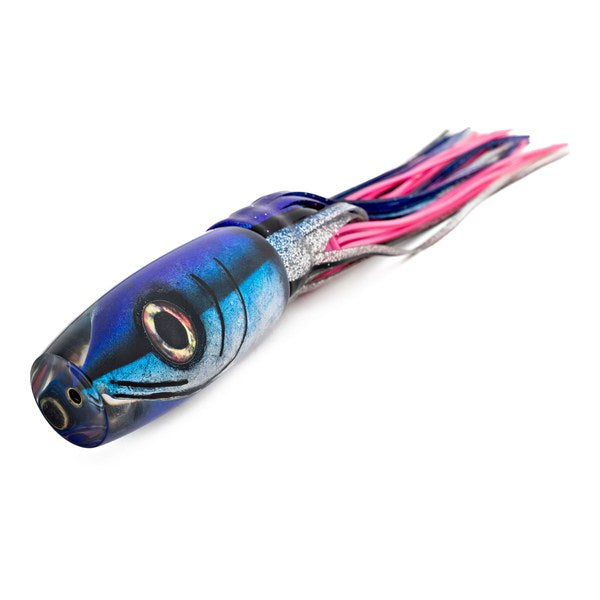
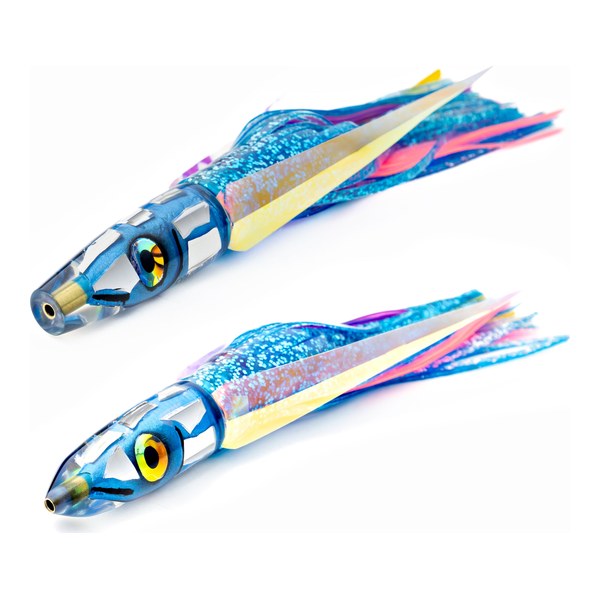
I run a 9-inch spread during ahi season. That is not a secret. But I keep a full box on the boat and there is a reason for every lure in it.
Once ahi season ends, or when I am out and my goal is not specifically to land a yellowfin, the 7-inch and 6-inch lures come out. Not because they catch ahi better, but because they are the right tool for a different job. Here is how I use them and why.
The longer your lure is, the more stable it runs. The shorter the overall length, the more movement and action you get. That is the rule everything else comes from.
A 9-inch bullet stays in its lane because it has the length to resist wave action. A 7-inch bullet of the same shape is shorter and lighter, so it moves more. That extra movement gets bites from fish that would pass a slow-tracking 9-inch. Off season, that is fine. During a 3-month ahi window it is a problem, and I explain that at the end.
The 7-inch runs all the same shapes as the 9-inch. The action and logic are the same. You are just working with a smaller, lighter profile that attracts a broader range of species.
| Shape | Action | What it targets |
|---|---|---|
| 7 in Bullet | S-turn, skitters | Mahi, small marlin, stripies, all-year general |
| 7 in Invert | Straight pop, stays down | All species, rough water, faster trolling |
| 7 in Cut Face | Surface splash, erratic | Mahi, small marlin, surface feeders |
| 7 in Ali’i Bullet | Heavy, stable, straight | Rough water, windy days |
| 7 in Ali’i Invert | Heavy cupped face, straight | Best rough-water 7-inch, faster speeds |
The 7-inch bullet is a good small marlin bait. When the stripeys are around, that is the shape I reach for first. Mahi will eat pretty much any 7-inch. Almost everything in the water will bite a 7-inch bullet if it is in the spread long enough.
The 7-inch invert is the shape I use most in the 7-inch class, and the reason is speed.
The cup face grabs water and that resistance keeps the lure in its spot even when I push the throttle up. Off season, I am not parked on a zone mowing the lawn. I am on the hunt, covering water, chasing bird piles or running structure. I tend to go faster in that mode, and the 7-inch invert stays in the water at those speeds where a bullet would blow out.
If you are making longer runs between spots or chasing birds across water you have not worked before, put the 7-inch invert on both corners and let it track. It handles the pace.
The Ali’i is to the 7-inch series what the H1 is to the 9-inch series. Heavier lead, longer head, more stable in rough conditions.
The Ali’i bullet tracks straighter than a standard 7-inch because of that extra weight and length. The Ali’i invert adds the cupped face on top of that, which makes it the most stable lure in the 7-inch class and the one that handles the most speed. If you are running 7-inch lures in rough water or pushing 8 to 9 knots, the Ali’i invert stays in the water when other shapes are blowing around.
If the standard 7-inch is a versatile all-year bait, the Ali’i is the version you reach for when the trades are cranking and you still want to cover water.
The 6-inch lures are for when you want to catch something. Not necessarily ahi, not necessarily mahi. Anything that eats.
Big aku will eat a 6-inch. Mahi love them. We have guys catching ahi on them too. The lure is small enough that very little in the water will look at it and swim away.
One thing worth knowing: the 6-inch is about the same overall length as a 7-inch, but the diameter is significantly smaller. It is a noticeably thinner profile. That narrow head is what drives the bite rate. The profile is small enough that very little in the water will pass it by.
Because the head is so small, the lure blows around more than a 7-inch or 9-inch. The invert face helps keep it in its spot, but in rough conditions the extra weight from running 7-inch skirts instead of 6-inch skirts makes a real difference. A heavier skirt holds the back of the lure down and steadies the swim.
I do not make a cut face in the 6-inch. Just the invert and the bullet.
A few years back I fished with Tim Tucker on his 31-foot Bertram. We ran a full spread, 8 lures total: six 9-inch and two 6-inch Peewee Invert Flyers on the corners.
The 6-inch corners were there specifically because there were big aku around, sheibbies in the 60-pound class. That size fish will eat a 6-inch before it hits a 9-inch, so I set them up as a secondary option.
On the way home, a marlin came up and bypassed every 9-inch in the spread. He hit the green 6-inch Peewee Flyer on the corner.
I see that a few times a season. A fish fixates on the smallest thing in the spread and ignores everything bigger. Running at least one or two smaller lures on the corners covers that scenario without breaking up your main pattern.
Here is why I do not run 7-inch or 6-inch lures during ahi season.
Ahi season in Hawaii is roughly 3 months. However many days you actually get on the water in those 3 months is your whole ahi season for the year. If you spend those days cranking up mahi and big aku on your 7-inch lures, you are trading ahi time for something else. Once that window passes, it is gone until next year.
I keep the 7-inch and 6-inch for everything else: off season, when I want to just catch something, and for any day where the specific goal is not a yellowfin. The 7-inch and 6-inch will still catch ahi if one decides it wants them. But I am not inviting bycatch and burning that limited window to find out.
For a full breakdown of why I run 9-inch across the board when ahi season opens, read the companion post: Why I Only Run 9-Inch Lures for Ahi (And Why 7-Inch Is a Trap During Season).
Comments will be approved before showing up.

I use two different skirting techniques depending on the material because thick and thin skirts behave differently at the fold point. In this post I cover the ring trim technique for thick skirts, why I use coconut oil as a lubricant, and the front skirt positioning that keeps both layers opening correctly.


The calendar says ahi season in Hawaii starts in June, but the last few years the fish have been showing up as early as January and March. Here is how I get the boat, the leaders, and the lure box ready before they arrive.

Join the Tsutomu crew for early drop alerts, fish reports, and tips from the water.
Drops sell out. Add your number and get a text on every drop and restock before Instagram or email finds out.
By providing your phone number, you agree to receive promotional and marketing messages, notifications, and customer service communications from Tsutomu Lures. Message and data rates may apply. Consent is not a condition of purchase. Message frequency varies. Text HELP for help. Text STOP to cancel. See terms, see Privacy Policy.
Here’s 15% off your first order. Tap the code to copy it, or shop now and it applies at checkout automatically.