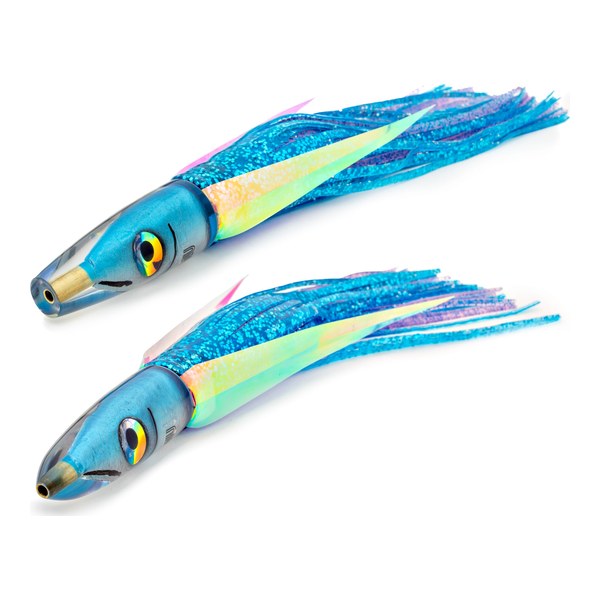
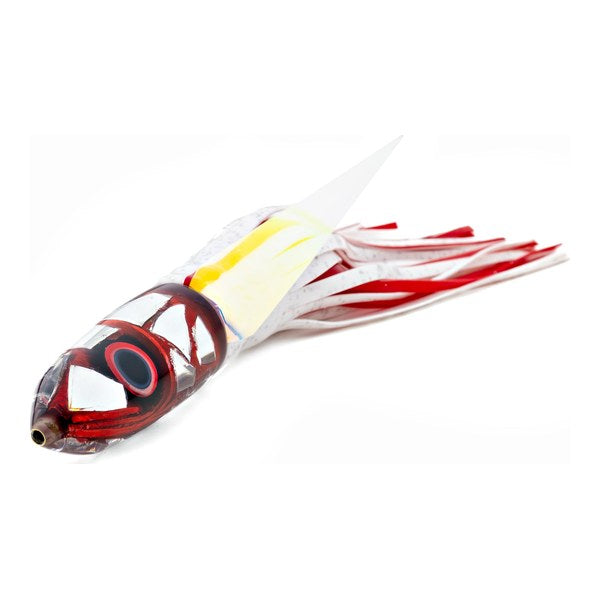
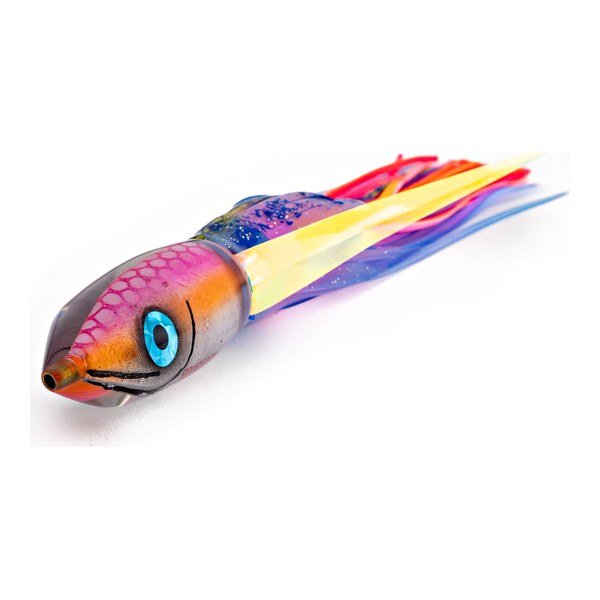
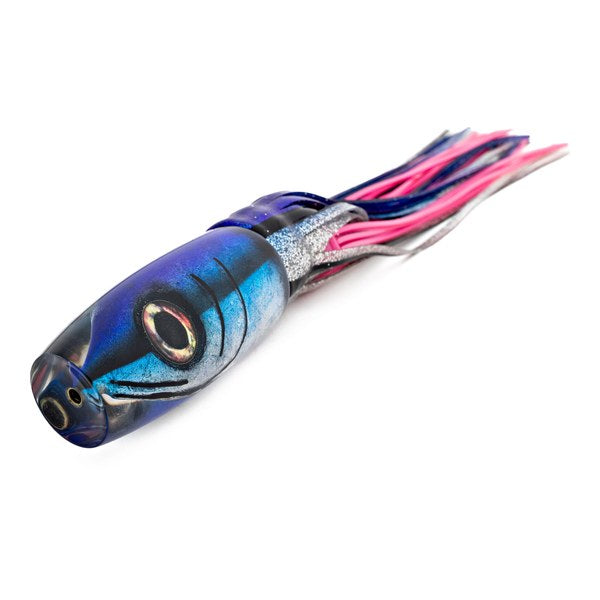
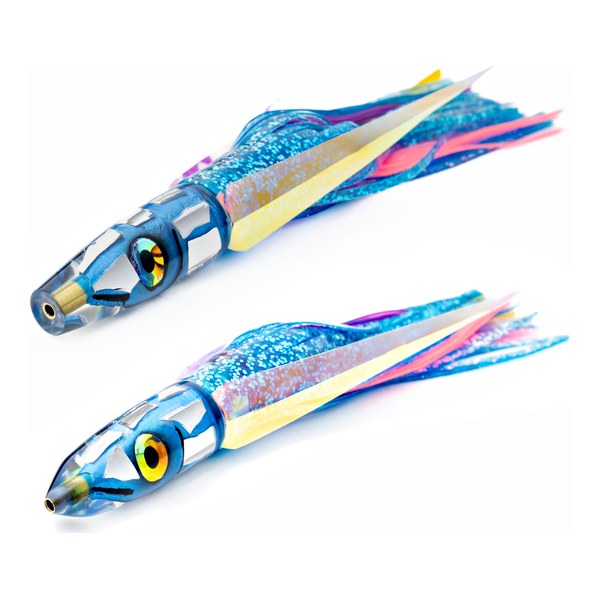
The blunt bullet is a lure you do not see around as much, and I hope that changes, because it earns its spot in the box. It is a shorter, fatter version of our bullet head. The nose is a lot blunter and rounder than a regular Moke bullet, and the steps on the lower head are shorter too. The whole point of that shape is to make the lure skitter along the surface more. In this post I want to explain why the short head moves the way it does, when I choose to run it, and the skirting details that get the most action out of it.
People tend to look at a lure from the tip of the nose to the back of where the skirts are tied on. But the action of the lure is dictated by the whole length of the head. That is why we shortened the steps on the blunt bullet, not just the nose.
Think of it like cars. A shorter head is like an F1 car. It is designed to swerve and move all over the track. A longer head, say our H1 bullet, is more like a dragster. It is long and stable and designed to stay straight. The regular Moke bullet sits in between, which is why it is the all purpose head that works in almost any condition. The blunt bullet is the specialty tool at the short end of that range. When the conditions are right, the extra skitter from this lure really helps you out.
I run this lure when the water is calm or medium rough. The blunt head makes it skate and skitter along the surface, and that is exactly what you want on the nicer days.
When the water gets really rough, I go the other way. A short head like this will end up skipping all around and jumping out of the water, and on a rough day you want your lure to stay in the water more. So on rougher days I reach for a longer, heavier, more stable head and save the blunt bullet for when the ocean lets it work.
This is what I was taught, and it has held up: a lot of guys like that skittering action along the surface for ahi. Plungers that splash the surface catch ahi too, but they also tend to attract the wrong customers. You want to be catching ahi, and you do not want to be fighting a marlin for an hour while everybody else around you is catching ahi.
The blunt bullet gives you a little bit more of a quiet action, but still enough action, especially when the water is nice. We have taken ahi on strikes in the blind on the 9 inch blunt bullet in Milky, driving along with no birds and no sign, which tells you the lure raises fish on its own.
I like this lure with two skirts on it instead of three, just so there is less drag. The whole purpose of the blunt head is to skitter along the surface, and every extra layer of skirt works against that.
Think of the skirts as the tail of a kite. With a long tail, the head has a lot of material it has to drag around. With a shorter tail, the head can move a lot easier. If you want to see how we actually tie a two skirt combo on a head, the method is in our post on how we tie and layer skirted trolling lures.
Here is a tip, especially if you fish a smaller boat. Most guys in Hawaii are fishing an 18, 19, or 21 foot boat, and your outriggers have a lot less angle than a bigger boat has. That lower line angle takes action away from your lures.
On the 9 inch blunt bullet I normally run 9 inch skirts, but you can squeeze 7 inch skirts onto this head, or chop your 9 inch skirts down. It is cheaper to just buy 7 inch replacement skirts and squeeze them on. That shortens the lure even more, and the shortness gives your lure more action off a small boat. That trick works on pretty much any lure you want to squeeze a little more action out of, but especially on a blunt bullet. Stick with the two skirt combo when you do it so the head stays free to move.
The blunt bullet I broke down on camera was an ice blue head with a blue salmon top skirt over a kajiki underskirt. For the guys who want the exact skirt codes, the blue salmon is a Yamashita SM-1, and the underskirt is the old school Kajiki 7. On that head I normally run something like a plum or an orange, yellow, and white underskirt, but the kajiki was what I had, and it caught.
We pour the blunt bullet in the 9 inch and the 7 inch in a handful of proven colors. If the forecast says calm to medium rough, put one out and let that short head do its work.
Comments will be approved before showing up.

Some of my best days started as busted ahi plans. Here is how I find and work floating rubbish in Hawaii, from hunting speed between piles to the six inch lures and Aku Bones that go in the water first when I break down.

I run a 9-inch spread during ahi season, but the 7-inch and 6-inch lures earn their spot in the box for everything else. Here is how I use each size, when I reach for the Ali’i heavy series in rough water, and why I pull them all out once that 3-month ahi window opens.

We sell or give away the best cuts of every ahi, and the fisherman keeps the rest. Here is how I smoke the head, why the meat around the eyes smells like crab, and how what is left turns into a really good head soup.

Join the Tsutomu crew for early drop alerts, fish reports, and tips from the water.
Drops sell out. Add your number and get a text on every drop and restock before Instagram or email finds out.
By providing your phone number, you agree to receive promotional and marketing messages, notifications, and customer service communications from Tsutomu Lures. Message and data rates may apply. Consent is not a condition of purchase. Message frequency varies. Text HELP for help. Text STOP to cancel. See terms, see Privacy Policy.
Here’s 15% off your first order. Tap the code to copy it, or shop now and it applies at checkout automatically.