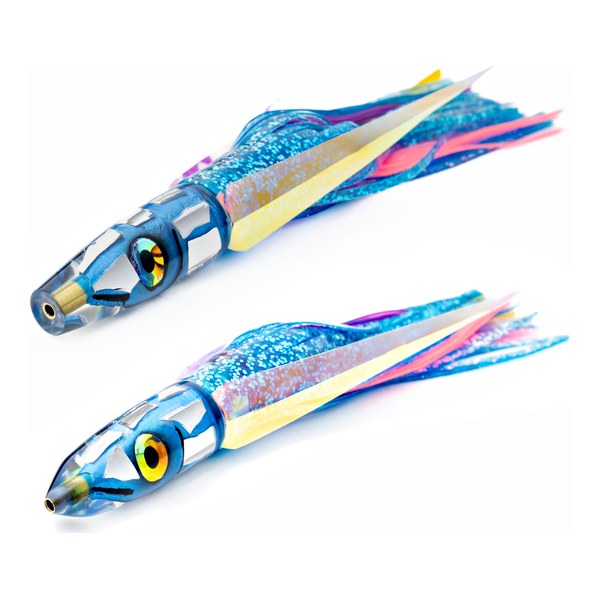
The question I get at the showroom more than almost any other is about hooks and line. What size hook, what pound leader, and whether to run one hook or two. Here is exactly what I use, by lure size, and why.
One note before we start. Most of you reading this are fishing Hawaii, which means you are meat fishing. This is a meat fishing setup, built to hook fish and keep them on.
I run a double in almost all of my lures. Two hooks, with the trailing hook set 180 degrees opposite the front one. The front hook is there for the fish that eats the head. The trailing hook covers the back, and that matters most with billfish. A marlin will come up and swat the back of the lure to disable it, the same way it kills a real baitfish by hitting the tail first, then circle back to eat. When it does, the trailing hook is right there.
The single hook has one main advantage, and it is at the boat. When a green fish is thrashing on the leader, one hook is a lot less to deal with around your hands and your crew than two loose hooks on a head shaking fish. It is also less hardware and one less thing to manage. But the double covers more of the bite, so that is what I run on most of my lures, and it is what the rest of this is about.
Here is what I run, and it changes with the lure:
| Lure | Hook |
|---|---|
| 9 inch bullet | Double open 9/0 |
| 9 inch invert or cut face | 10/0 |
| 7 inch | Double 9/0 or the Japanese double hook |
| 6 inch | 9/0 or the Japanese double hook |
On my 9 inch bullets I run a smaller double 9/0, and that is on purpose. When an ahi comes up on a bullet he inhales it with a mouthful of water, and a 9/0 gets sucked down easier. You end up hooking him deep in the throat or even in the gills, which makes him fight a lot less.
On my 9 inch inverts and cut faces I jump up to a 10/0. Those lures move around a lot more, so they are not as clean a target, and the bigger hook has more grabbing area. A 10/0 also tends to tangle the front hook less on a three skirted invert or cut face.
The Japanese double hook is a lot of hook on a small bullet, but the fish do not seem to mind. When the lure hooks up, that hook spreads apart, and once it is in, for the most part it is not coming off.
Leader is cheap relative to what it saves you, so do not baby a worn one. If it is going milky, or you nicked it, or you just landed a big marlin or ahi on it, change it. It will save you fish and lures.
| Lure | Leader |
|---|---|
| 7, 9, and 12 inch | 300 lb |
| 6 inch and small lures, ahi season | 200 lb |
| 6 inch and small lures, off season for aku | 130 lb |
My 7, 9, and even 12 inch lures all get 300 lb test. That will land anything I want to catch, mahi, ahi, or marlin. My theory is if it is big enough to break 300, I did not want it anyway.
On my small lures it depends on the season. Off season, when I am dragging small lures for aku, I will drop to 130 lb. But during ahi season I bump the small lures up to 200 lb. If an ahi is lurking around the pile and grabs your little lure, 200 lb gives you a real good chance of landing him instead of getting broken off. For line I stick to POPI Platinum, Momoi Hi-Catch, and Maxima.
I build the hook rig on 500 to 600 lb cable with 1.9 crimps, over open gap stainless hooks. First I burn a mushroom on each end of a piece of chafe tubing and run it through the lure head, so the leader is not sawing on the plastic. I set the trailing hook so its eye sits right about where the front hook starts to bend. If it ends up a touch long, I do not mind.
When you crimp, do not crimp right on the edge. Come in a touch, and put the most pressure on the center so the crimp ends up shaped like a dog bone. A crimp mashed flat on the edge can start to wear into your mono and cut it. On both ends I make a Flemish eye before I crimp, so if a crimp ever slips, the knot cinches down and holds instead of letting go.
A lot of guys ask if I try to tuck the trailing hook up in the skirt. I do not. Look at how the marlin guys rig, most of their hooks hang out the back anyway. The fish cannot tell it is a hook, and running at speed that trailing hook flops around back there and looks like a tail wagging. I am not an IGFA guy, and their rule is the eye of the hook cannot sit outside the skirt. My thinking is simple, if that is considered cheating, it must be an advantage.
I hold the trailing hook in line with a small zip tie, not shrink wrap. Shrink wrap locks the back hook down. I want it free. The zip tie is only there to keep the trailer from flopping all over while I am trolling, and it is strong enough to hold it in place but breaks the moment a fish bites. Once it breaks, if the fish missed the trailing hook on the first pass, that hook is now free to swing and sink back into him as he runs and fights. No zip tie handy? A rubber band or a piece of skirt leg does the same job.
Both rigs are options on the lure page. Choose Pro Staff Double SS for the two hook rig I run, or Meat Fish Single SS for a clean single. Browse the lures and rig it the way you fish. Any questions, send me a message.
Comments will be approved before showing up.

Some of my best days started as busted ahi plans. Here is how I find and work floating rubbish in Hawaii, from hunting speed between piles to the six inch lures and Aku Bones that go in the water first when I break down.

I run a 9-inch spread during ahi season, but the 7-inch and 6-inch lures earn their spot in the box for everything else. Here is how I use each size, when I reach for the Ali’i heavy series in rough water, and why I pull them all out once that 3-month ahi window opens.

We sell or give away the best cuts of every ahi, and the fisherman keeps the rest. Here is how I smoke the head, why the meat around the eyes smells like crab, and how what is left turns into a really good head soup.

Join the Tsutomu crew for early drop alerts, fish reports, and tips from the water.
Drops sell out. Add your number and get a text on every drop and restock before Instagram or email finds out.
By providing your phone number, you agree to receive promotional and marketing messages, notifications, and customer service communications from Tsutomu Lures. Message and data rates may apply. Consent is not a condition of purchase. Message frequency varies. Text HELP for help. Text STOP to cancel. See terms, see Privacy Policy.
Here’s 15% off your first order. Tap the code to copy it, or shop now and it applies at checkout automatically.